Free music lesson invoice template
Fill it in below and print it or save it as a PDF — or download a blank template for Word, Google Docs or a spreadsheet. Built for piano, guitar and voice teachers. Free, no sign-up, and nothing you type leaves your browser.
Everything stays in this browser. Your studio name and payment note are remembered on this device so you don’t retype them; nothing is uploaded.
Your studio
Invoice
#001
Bill to
Family name
Issued —
| Date | Description | Qty | Rate | Amount |
|---|---|---|---|---|
| Add a lesson to see it here. | ||||
What to put on a music lesson invoice
A lesson invoice has one job beyond asking for money: it should answer, without a reply email, the question which lessons is this for? Nearly every billing dispute in a teaching studio is really a disagreement about what was covered, not about the rate.
- Your studio name and contact details. Whatever the family will search for when the payment fails.
- Who is being billed, and for which student. Name both. The parent paying and the child learning are different people, and in a two-sibling household the invoice is ambiguous without it.
- An invoice number and date. Sequential, never reused. This is the reference you will write beside the payment when it lands.
- One line per lesson, with its date. This is the part people skip and the part that does the work. “September tuition — $140” invites a query; four dated lines do not.
- Anything that is not a lesson, itemised separately. Exam entry fees, recital accompaniment, books you bought on their behalf.
- The total, and how to pay it. Name the method and the exact address or account. “e-Transfer” alone is not instructions.
- A due date. An invoice without one is a statement, and gets treated like one.
Per lesson, monthly, or by term
Per lesson is the most accurate and the most work: the amount is never wrong, but you are collecting small sums continuously and chasing the ones that slip.
Monthly, itemised by lesson date is what most private studios settle on. It is small enough that a family pays it without a conversation, and detailed enough that they can see exactly what they are paying for. Because months contain four or five lessons depending on the calendar, the total moves — which is fine, as long as the lines explain it.
By term means one invoice and one payment, which is excellent for your admin and hard on a family’s budget. If you bill termly, say up front what happens when a student withdraws mid-term, and send the invoice before the term starts rather than after.
Missed lessons, makeups, and the line that prevents the argument
Put the policy on the invoice, not only in the studio agreement a parent read once in September. One sentence is enough, and it should say three things: what notice is required, what happens without it, and whether a makeup is offered.
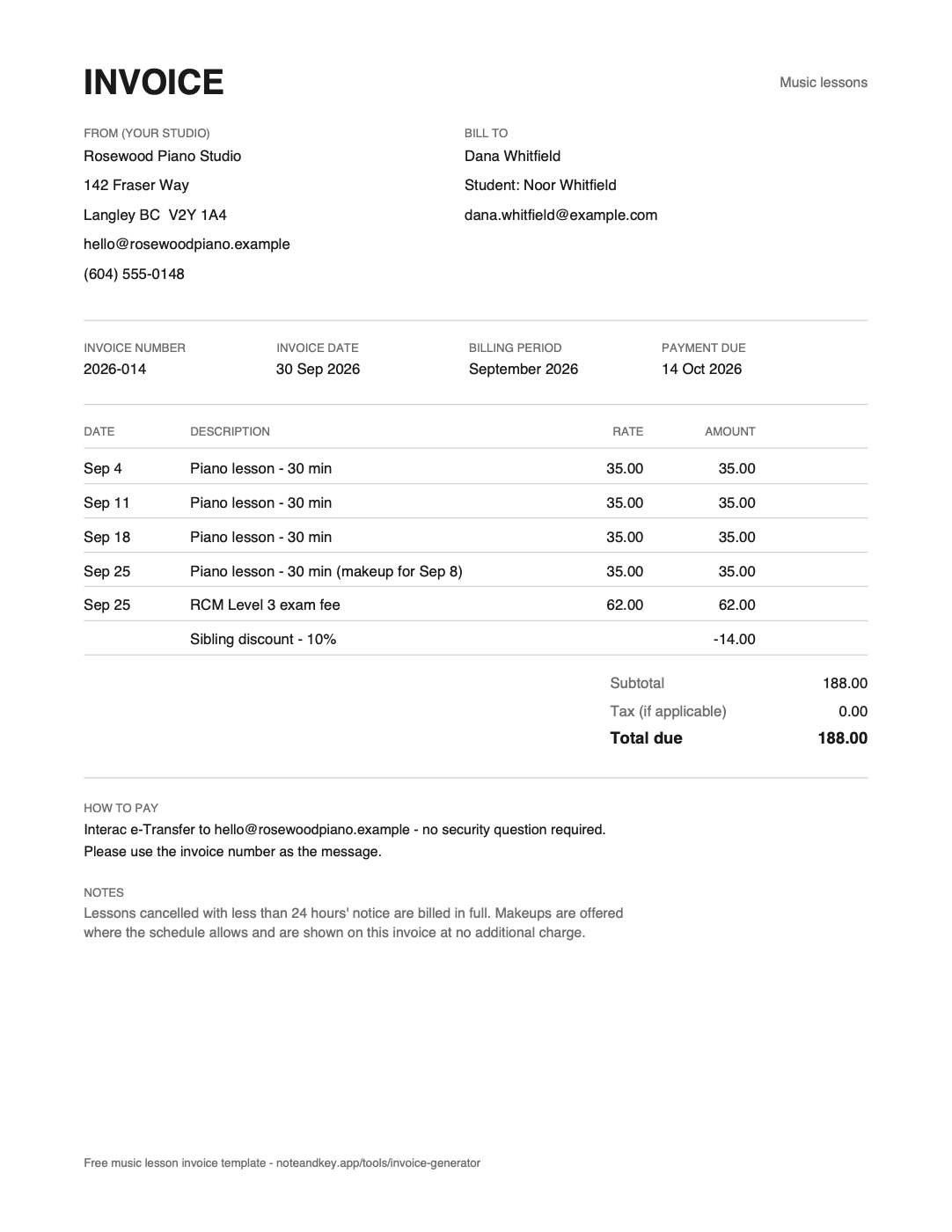
A workable version: “Lessons cancelled with less than 24 hours’ notice are billed in full. Makeups are offered where the schedule allows and appear on this invoice at no additional charge.” Then actually show the makeup as a line at zero, or as a normal line labelled “makeup for 8 Sep”. A makeup that is invisible on the invoice reads to a parent as a lesson they were charged for twice.
Sibling discounts
Two siblings usually means one invoice to one parent, with both students named and each child’s lessons itemised under their own name. Apply the discount as a visible negative line against the subtotal rather than by quietly reducing the rate — a discounted rate buried in the per-lesson figure is a discount the family never notices they are getting, and it makes the invoice impossible to reconcile against your standard rate later.
A filled-in example
Four weekly lessons, one of them a makeup, an exam fee, and a sibling discount — the shape most monthly studio invoices end up in.
For piano teachers
Piano studios carry the most non-lesson billing of any instrument: exam entries (RCM, ABRSM, AMEB, Trinity), festival fees, accompaniment for someone else’s exam, and books bought on a family’s behalf. Itemise each one rather than folding it into tuition — an exam fee is a pass-through cost, and a parent who can see it as its own line does not read the month as a price rise. If you teach siblings, which piano teachers do more than most, the discount line above matters.
For guitar teachers
Guitar studios run the widest mix of lesson lengths and formats — 30 and 60 minutes, in person and online, one-to-one and small group — often for the same student in the same month. Put the length and the format in the description on every line, because a column of identical “Guitar lesson” entries at different rates is the fastest way to get an email asking why. Strings and consumables you supply belong on their own line, not inside the lesson rate.
For voice teachers
Voice studios bill things no instrumental teacher does: accompanist fees for lessons and performances, audition and recital coaching in blocks, and repertoire bought per student. Accompanist cost in particular should be a separate line with the accompanist named — it is usually money passing through you rather than income, and burying it in the lesson rate makes your tuition look higher than it is and your bookkeeping harder than it needs to be. Illness cancellations are also far more common in a voice studio, so a sick-voice clause is worth stating explicitly alongside the 24-hour policy.
Doing this every month for twenty families?
This page is fine for one invoice. It is not fine for a studio — you still have to remember who you taught, look up each rate, and rebuild the whole thing next month. Note & Key does it from the schedule: mark lessons completed as you teach them, then generate a draft invoice per family with one line per uninvoiced lesson, sibling discounts applied, already-billed lessons skipped.
No card required · How invoicing works · Pricing
Common questions
Is this music lesson invoice generator free?
Yes. It is free, there is no sign-up, and there is no limit on how many invoices you can make.
Does anything I type get uploaded?
No. The invoice is built in your browser and never sent to a server. Your studio name, email and payment note are remembered on this device only, so you do not have to retype them next time.
How do I save it as a PDF?
Press Print / Save as PDF, then choose 'Save as PDF' as the destination in your browser's print dialog. Only the invoice prints — the form around it is hidden automatically.
What should a music lesson invoice include?
Your studio name and contact details, the family being billed, an invoice number and date, one line per lesson with its date and rate, the total, and how you want to be paid. Itemising each lesson by date is what stops the 'which lessons is this for?' reply.
Can I use it for guitar, voice or any other instrument?
Yes. The description on each line is free text, so it works for any instrument, for group classes, and for things like recital accompaniment or exam fees.
Can I charge tax on lesson fees?
The tool has an optional tax percentage that applies to the subtotal. Whether you should charge tax depends on where you teach and your registration status, so check with your own tax authority or accountant.
Can I use this template in Google Docs?
Yes. Download the Word (.docx) version, then in Google Drive choose New → File upload, right-click the uploaded file and pick Open with → Google Docs. For a spreadsheet, download the .csv and use File → Import in Google Sheets — the subtotal and total columns are already set up as formulas.
How should I number music lesson invoices?
Use a scheme that sorts and never repeats: year-and-sequence like 2026-014, or year-month-student like 2026-09-WHITFIELD. What matters is that the number on the invoice is the same number you write beside the payment when it arrives, because that is the link that makes a year of e-Transfers reconcilable.
Do I bill per lesson, per month, or per term?
Monthly is the usual compromise. Per-lesson billing is accurate but means chasing small amounts constantly; termly billing is one invoice but asks a family for several hundred at once. Monthly, itemised by lesson date, keeps the amount small enough to pay without thinking and detailed enough that nobody asks what it covers.
Is there a way to stop building invoices by hand?
Yes — that is what Note & Key does. Mark lessons completed as you teach them and it generates the draft invoice for each family from the lessons themselves, skipping anything already billed. Every new studio starts with 30 days of Pro, no card.